A LEADERSHIP DISCIPLINE FOR THE AI ERA
MANAGE
INTENT.
NOT TASKS.
Execution is faster than ever. Output is high.
Yet decisions stall, alignment slips, and leaders get pulled back into the work.
The issue isn’t effort. It’s that direction isn’t being managed.
SCROLL TO EXPLORE
The constraint has shifted
For years, execution was the bottleneck. Task management made sense because work was hard to produce and progress was easy to track.
That environment no longer exists.
AI has made execution abundant. Teams can generate faster than they can evaluate. The constraint is no longer getting work done. It’s turning that work into something coherent.
Direction is now the scarce resource.
When direction breaks down
Decisions keep escalating to leadership
Teams produce strong work that still misses the mark
The same alignment conversations repeat across meetings
Output increases without clear impact
Leaders stay involved longer than expected just to keep work on track
Most organizations interpret this as an execution problem. It isn’t.
What this changes in practice
These are not edge cases.
Leadership Team Alignment
Before
Leadership was deeply involved, but decisions still cycled back. Teams moved quickly, but not in the same direction.
Shift
Clarified decision ownership, evaluation criteria, and boundaries before execution began.
After
Decisions landed closer to the work. Escalation dropped. Leadership involvement became selective instead of constant.
Product / GTM Misalignment
Before
Both teams were active, but priorities diverged. Output increased without improving outcomes.
Shift
Established shared intent, success criteria, and constraints upfront.
After
Work aligned around a common direction. Fewer resets. Faster execution with less coordination overhead.
AI Adoption Without Clarity
Before
AI increased output, but also increased options. Teams generated more than they could evaluate.
Shift
Defined how options would be assessed and who had authority to commit.
After
Faster decisions. Less rework. Output translated into measurable progress.
The work doesn’t slow down. It becomes coherent
Where this work typically starts
This usually begins when:
Execution looks strong, but progress is uneven
Leaders are pulled back into decisions they expected to delegate
Teams are active, but not aligned
AI adoption increased output, but not clarity
If this is familiar, the issue is likely not execution. It’s direction.
Assess your current operating model
In a 30-minute working session, we’ll:
Identify where decisions are stalling
Map where direction is unclear or missing
Highlight the highest-leverage point to address
No preparation needed.
WHAT IS INTENT MANAGEMENT™?
T H E D I S C I P L I N E
01
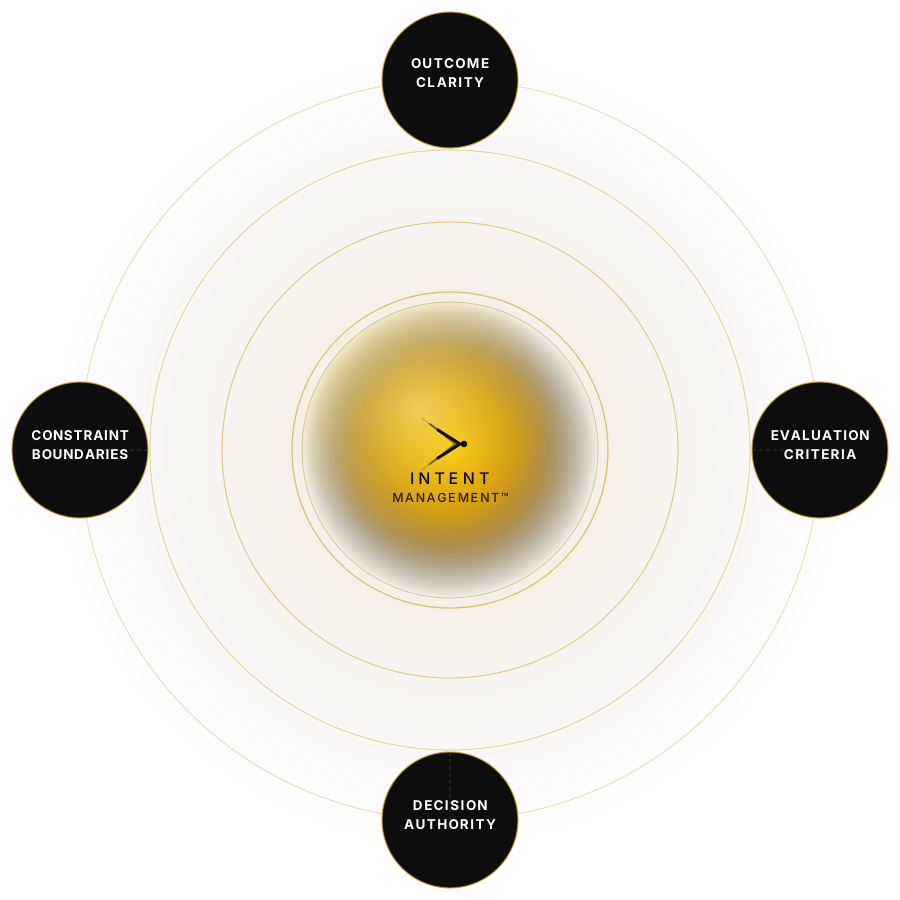
Define the Outcome
Clarify what "done" means before work begins. In fast-moving environments, outcomes must be defined before momentum builds — not discovered as work progresses. Without shared understanding of success, teams move energetically in diverging directions.
It is not a process layered onto existing work. It is a shift in where leadership attention goes — less effort spent correcting misalignment after it appears, more effort spent shaping direction so alignment can last on its own. When leaders manage intent deliberately, work moves with less friction, and leadership becomes more sustainable as acceleration becomes the environment rather than a phase.
FOUR ELEMENTS OF INTENT
Intent Management™ is a leadership discipline designed for environments where speed is high and intelligence is always available. It centers on four interdependent elements that form a continuous rhythm — not a checklist, but a way of leading.
"When pace is constant and options arrive early, alignment no longer forms naturally. Leaders must shape direction before execution gains momentum."
02
Set Constraint Boundaries
Define where work is supposed to stop. Without stated limits, everything stays in play. Every reasonable suggestion expands scope. Constraint boundaries protect focus before energy is spent and prevent well-intentioned effort from becoming endless exploration.
03
Establish Evaluation Criteria
Name what good looks like before output multiplies. When AI generates options faster than teams can evaluate them, leaders who pre-define quality allow distributed judgment to work. Without evaluation criteria, more output creates more indecision.
04
Anchor Decision Authority
Clarify who decides what, before decisions need to be made. Distributed execution works only when decision rights are visible. Ambiguous authority doesn't slow decisions — it stops them, or creates the wrong ones made by the wrong people at the wrong time.
YOU MAY ALREADY BE FEELING IT
The leadership shift driven by AI doesn't arrive with a clear announcement. It arrives when the distance between decision and consequence collapses. These are the signals that the shift is already underway in your organization.
͢
͢
͢
͢
͢
͢
R E C O G N I Z E T H E S H I F T
Your time is increasingly spent making sense of competing signals rather than directing execution.
Others look to you to reduce options and validate direction as work unfolds.
Decisions feel heavier, even when they resemble ones you've made many times before.
Your involvement is pulled earlier into the work — before problems fully form.
Leadership impact depends more on judgment and steadiness than on expertise or visible output.
Capable teams deliver high output, yet a quiet sense of uncertainty persists about direction.
"AI accelerates execution, compresses feedback loops, and multiplies the consequences of unclear direction. As speed increases, alignment must exist before action begins."
THE LEADERSHIP SHIFT IN AN AI WORKPLACE
"The difference is leadership discipline, not technical sophistication."
THE LEADERSHIP SHIFT IN AN AI WORKPLACE
T H I N K I N G & W R I T I N G
Model
The shift from managing tasks to managing intent isn’t philosophical. It’s a practical response to what happens when execution outpaces alignment.
LEADERSHIP
When AI compresses feedback loops, leaders who invest early - before work gains momentum - retain leverage. Those who wait lose it.
AI & ORGANIZATIONS
Organizations now have more intelligence available than ever. The bottleneck has shifted - from generating options to evaluating and committing to them.
E N G A G E M E N T S & W O R K S H O P S
BRING THIS
THINKING
TO YOUR TEAM
Intent Management™ is not a theory. It is a practical leadership discipline built for the real operating conditions leaders face today — where speed is constant, intelligence is abundant, and judgment remains human.
30-minute working session. We’ll map where direction is breaking down and why.
Keynotes · Executive Workshops · Leadership Offsites · Team Sessions